
Enhancing VoIPmonitor 2026.02.0: Advanced Sensor Monitoring Disk I/O Analytics and PII Masking
Overview of the recent features introduced in VoIPmonitor’s 2026.02.0 release, focusing on sensor monitoring, disk I/O analytics, and PII masking. Designed for developers, operators, and technical buyers, it summarizes the key capabilities and setup procedures, ensuring users can leverage these tools effectively.


1. Advanced Sensor Monitoring and Disk I/O Analytics
1.1 New Disk I/O Monitoring System
The latest release significantly improves disk performance insights through a comprehensive monitoring system, including:
-
Automatic Baseline Calibration:
On startup, the system calibrates disk throughput and latency, detecting external I/O loads to avoid inaccurate baseline measurements. If calibration occurs under load, auto-recalibration triggers once the disk is idle. -
Real-time Metrics:
Continuous monitoring encompasses disk utilization percentage, capacity relative to the calibrated knee point, throughput (MB/s), IOPS, write latency compared to baseline, and I/O queue depth. -
Saturation Detection:
The system automatically flags when the disk cannot keep pace with spool writes, with statuses such asDISK_SATorIO_WARN. Additional indicators includeWAIT_CALIB(waiting for idle disk), andRECAL_PEND(pending recalibration). -
Graphical Insights:
Three RRD graph types provide visual analysis:- Disk I/O saturation (% and capacity)
- Disk throughput (MB/s and IOPS)
- Latency with queue depth
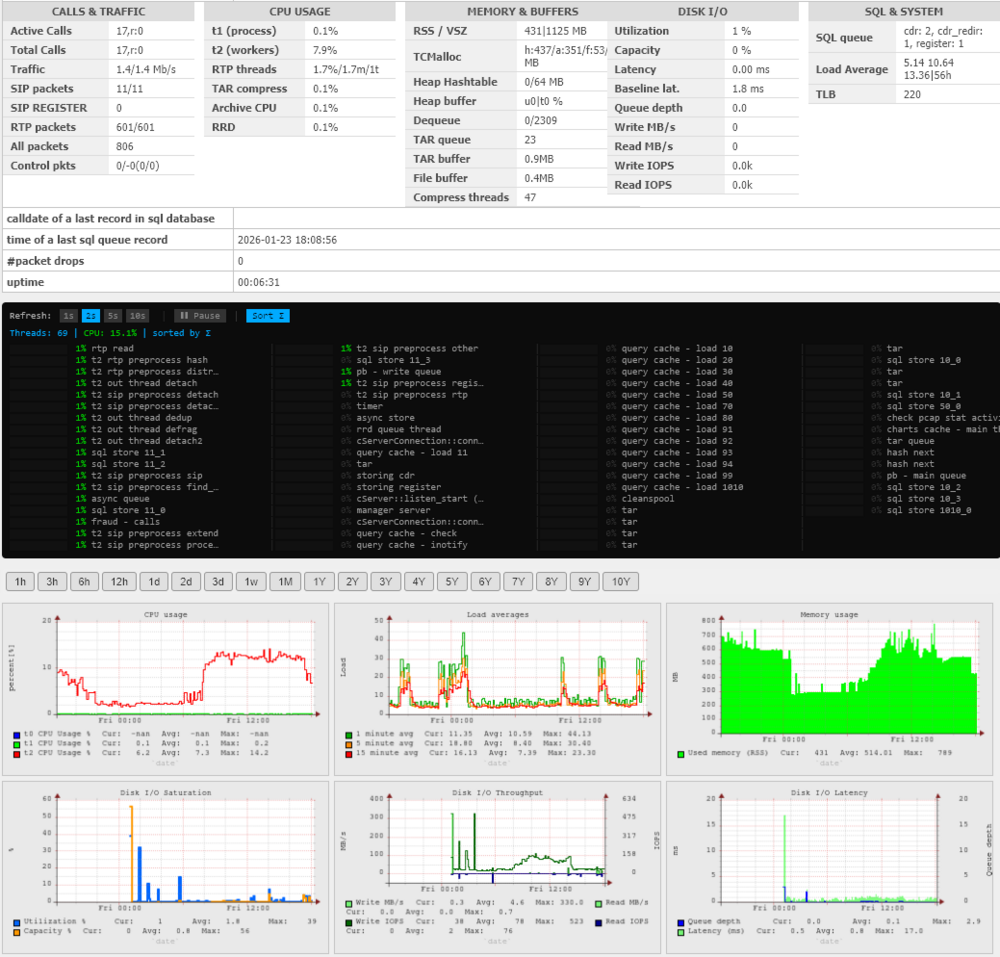
1.2 Redesigned Sensor Detail Page
The GUI now features a unified sensor detail page, integrating:
-
Statistics Dashboard:
An organized table delivering real-time metrics across calls, CPU, memory, disk I/O, SQL, and system resources. -
Real-time Thread Monitor:
Live CPU clampdowns with sparkline graphs per thread, sortable by CPU usage, highlighting potential bottlenecks. -
RRD Performance Graphs:
Period-selectable graphs display CPU load, memory, disk I/O issues, network activity, and packet statistics, enhancing historical analysis and troubleshooting.
1.3 Configuration & Availability
Disk I/O monitoring is enabled by default when spooldir is set, with configurable warning thresholds:
; voipmonitor.conf example
disk_io_monitor = yes
disk_io_warning_threshold = 80
disk_io_saturation_threshold = 95
Available in sniffer versions 2026.01.3+ and GUI versions 2026.1.3+.

2. PII Phone Number Masking and Anonymization
2.1 Masking Modes
VoIPmonitor 2026 offers robust phone number anonymization modes:
-
Redact:
Replaces digits with a character, e.g.,XXXXXXXXXXXXXorREDACTED. All masked numbers appear identical, making correlation impossible. -
Hash (Default):
Uses HMAC-SHA256 with apiih_prefix to produce consistent, non-reversible tokens for each number, preserving the possibility to perform statistics and filtering. -
Encrypt:
Applies AES-128-CTR encryption with a secret key (piie_prefix). It supports reversible anonymization, allowing original numbers to be recovered when necessary, using the secret key.
| Mode | Reversible | Correlation | Description |
|---|---|---|---|
| Redact | No | No | Replaces digits with placeholders |
| Hash | No | Yes | Produces consistent tokens, suitable for analytics |
| Encrypt | Yes | Yes | Reversible encryption with secret key |
2.2 PCAP Anonymization & Configuration
SIP headers in saved PCAP files are masked directly during packet capture. Users can specify headers to mask via:
pii_sip_headers = from; to; contact; p-asserted-identity; p-called-party-id
Caller display names and authorization usernames are anonymized by default, configurable via pii_anonymize_callername and pii_anonymize_username.
2.3 Quick Setup Guide
To enable masking with default hash mode:
pii_enable = yes
For reversible encryption:
pii_enable = yes
pii_masking_secret = your-secret-key-here
2.4 Availability
This functionality is supported in sniffer version 2026.02.0 and newer.
3. Final Remarks and Next Steps
VoIPmonitor’s 2026.02.0 upgrade introduces critical capabilities that enhance performance monitoring and privacy compliance. The new disk I/O analytics enable proactive bottleneck detection, while the robust PII masking ensures organizations can meet privacy standards without sacrificing data utility.
For detailed configuration instructions and to deploy these features, consult the official documentation and support channels. Regular updates and feedback help improve VoIPmonitor’s capabilities further.