
TelcoBridges Tmedia TMG800 Media Gateway
Introduction
The TelcoBridges Tmedia TMG800 is a low-density, carrier-grade VoIP media gateway designed for service providers requiring cost-effective, high-performance voice processing. This documentation outlines the technical specifications, signaling capabilities, media processing features, and operational management of the TMG800.
Audience: Network engineers, system integrators, and service providers deploying voice infrastructure.
Scope: This document covers hardware interfaces, voice/media processing, signaling protocols, redundancy configurations, and management interfaces.
Product Overview and Form Factor
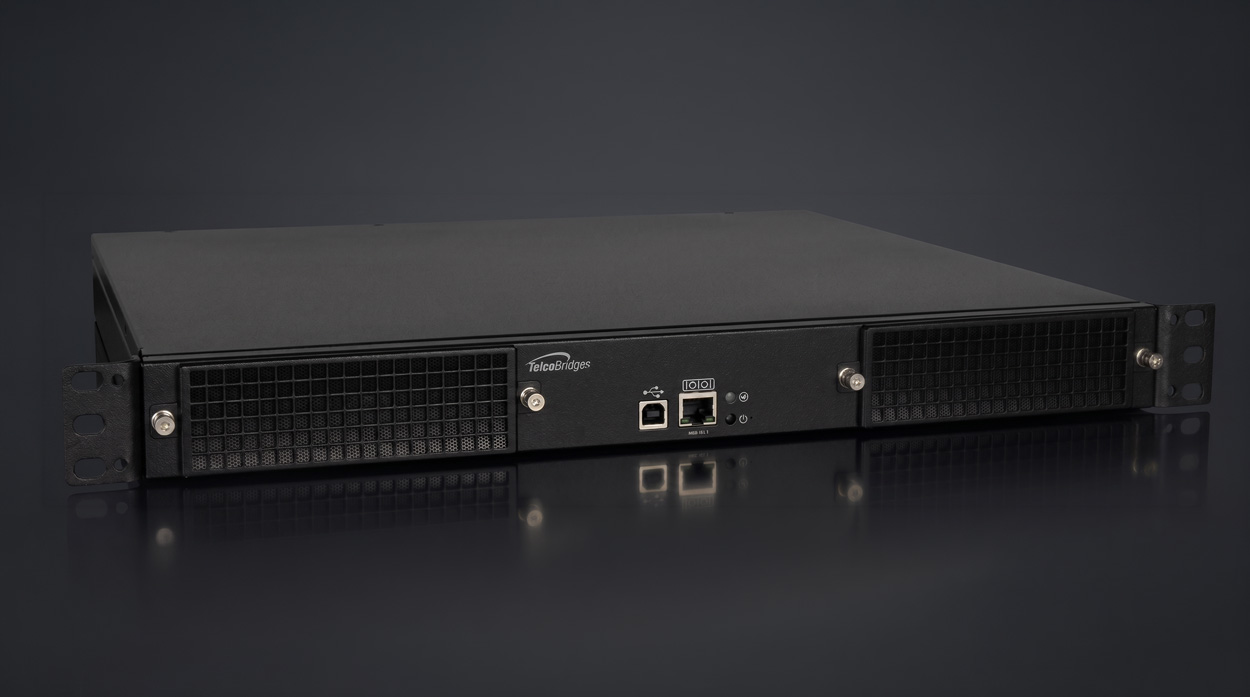
The TMG800 is a 1U, 19” rackmount unit designed for flexibility and scalability. It supports software-upgradable T1/E1 interfaces, allowing capacity expansion from 1 to 16 T1/E1 lines in single increments.
- Form Factor: 1U, 19” rackmount
- VoIP Channels: 32 to 512 (universal codecs)
- T1/E1 Ports: 1 to 16 (software upgradeable)
- Power: Dual feed redundant power supplies (AC or DC)
The gateway supports the Tmedia 1+1 solution, extending high-availability features through active/standby redundancy for both TDM and IP traffic.
Hardware Specifications
Physical Interfaces
The TMG800 provides diverse connectivity options for PSTN, VoIP, and management traffic.
| Interface Type | Specifications |
|---|---|
| PSTN (T1/E1) | 1 to 16 ports; configurable per port for T1 or E1; RJ48C connectors; port status LEDs. |
| VoIP (Ethernet) | Up to 6 ports (100/1000Base-T); RJ45 connectors; up to 16 different IP addresses. |
| Ethernet Features | Port bonding, 802.1q VLAN support. |
| Management | 2 Ethernet ports (100/1000Base-T); 1 USB Type B serial port. |
Dimensions and Weight
| Component | Dimensions (H x W x D) | Weight |
|---|---|---|
| TMG800 Gateway | 1.75” (44.5 mm) x 16.9” (429 mm) x 16” (406 mm) | 14 lbs (6.4 kg) |
| 1+1 Patch Panel (8 T1/E1) | 1.75” (44.5 mm) x 16.9” (429 mm) x 5.25” (133 mm) | 3.4 lbs (1.6 kg) |
Electrical Characteristics
- Input Voltage: 90 to 260 VAC (47 to 63 Hz) or -32 to -72 VDC.
- Power Consumption: Maximum 70W.
- Redundancy: Dual feed redundant power supplies (AC or DC).
Voice and Media Processing
The TMG800 supports comprehensive voice processing features, including universal and proprietary codecs, fax/modem/data handling, and echo cancellation.
Vocoding
- Universal Codecs: G.711, G.723.1, G.726, G.729ab, T.38 V.17, Clear Mode (RFC 4040).
- Additional Codecs: G.722, G.722.2 (AMR-WB), G.728, G.729eg, iLBC, AMR, EVRC, GSM FR/EFR, QCELP, T.38 V.34.
Fax, Modem, and Data
- Fax Relay: T.38 (V.17 and V.34).
- Fallback: Automatic G.711 fallback.
- Data: Modem and data pass-through; NSE and VBD support.
- Clear Mode: RFC 4040 support.
DTMF and Echo Cancellation
- DTMF Relay: RFC 2833/4733, SIP INFO method, in-band.
- Echo Cancellation: G.168 standard; 128 ms echo tail on all channels simultaneously.
Voice Processing
- Jitter Buffer: Adaptive and programmable (20 to 200 ms).
- Voice Activity Detection (VAD): Supported.
- Comfort Noise Generation (CNG): Supported.
- Recording/Playback: Optional voice recording and announcement playback (up to 512 channels).
Signaling Protocols
The TMG800 simultaneously supports any combination of the following signaling protocols:
SIP (Session Initiation Protocol)
- Supported RFCs: 2327, 2833, 2976, 3204, 3261, 3262, 3263, 3264, 3311, 3323, 3325, 3326, 3372, 3389, 3398, 3515, 3551, 3555, 3578, 3581, 3665, 3666, 3764, 3891, 4028, 4694, 4733, 5806.
- Features: SIP-I/SIP-T support, extensive SIP header manipulation.
SS7 (Signaling System No. 7)
- MTP2 Links: Up to 64 links (56, 64, or n x 56/64 kbps) or 2 x HSL.
- Redundancy: Multiple redundant MTP2 links.
- Point Codes: Up to 64 originating point codes and 256 linksets; up to 256 destination point codes.
- ISUP Variants: ITU 92, ITU 97, ANSI 88, ANSI 92, ANSI 95, Q.767, Telcordia 97, ETSIv2, ETSIv3, China, Singapore, UK, SPIROU, Japan NTT, Russia.
SIGTRAN
- Protocols: M2PA, M2UA, M3UA (IPSP, ASP, SG), IUA.
- Transport: SCTP (raw IP and UDP).
- Capacity: Up to 64 M2UA/M2PA links; up to 64 M3UA peer server processes.
- SS7 Handling: Termination and/or relay supported.
ISDN PRI and CAS
- ISDN PRI: Q.931 ISDN PRI (user and network side).
- Variants: NI-2, 4ESS, 5ESS, DMS-100, DMS-250, Euro, ETSI NET5 (France, Germany, UK, China, Hong Kong, Korea), Euro Numeris (VN6), NTT (Japan), Australia, NFAS.
- CAS: MFC R1 (including E&M, loop start, ground start) and MFC R2 (including standard ITU, Brazil, Mexico, Venezuela). Customizable script files available for any CAS variant.
GR-303 and H.248
- GR-303: Call Control support.
- H.248 (MEGACO): ITU-T versions 1 and 2; UDP transport; DTMF and fax detection; call progress, DTMF, and COT tone generation; call quality and inactivity alerts; control port redundancy (supports virtual IP); conferencing; CLIP (H.248.23); redundancy with no loss of calls.
High Availability and Redundancy
The TMG800 ensures carrier-grade reliability through hardware and software redundancy features.
Standard Redundancy
- Power: Dual feed redundant power supplies.
- IP Ports: Redundancy supported.
- Software: Self-recovery software.
- MTP2/SS7: Links redundancy.
Tmedia 1+1 Solution
The optional Tmedia 1+1 solution provides active/standby VoIP gateway redundancy with full capacity protection for both TDM and IP traffic.
Components:
- 1 Active Tmedia unit.
- 1 Standby Tmedia unit.
- 1 or 2 Tmedia 1+1 Patch Panel(s) (passive, no power required).
Features:
- Configuration database redundancy.
- Seamless software upgrade.
- Fault-tolerant software.
- M3UA/MTP3/ISUP redundancy.
Management, Analytics, and Security
OAMP+T Interface
The TMG800 includes a web-based Operation, Administration, Maintenance, and Provisioning (OAMP) interface with Transport management.
- Configuration: GUI and CLI interfaces; configuration change audit logging.
- Access Control: User and privilege management.
- Monitoring: SNMP V2/V3 GET, TRAPs (alarms), extensive SNMP call statistics MIBs.
- System Management: GUI-based and CLI system upgrade; configuration copy, backup, and restore; storage for multiple software versions and configuration files.
- Provisioning: Non-service affecting configuration changes; offline configuration validation; multiple configuration files archive; machine-to-machine configuration interface.
Network Analytics (TB Analytics)
- Live Call Trace: Protocol information and ladder diagram.
- Live Test Call: Media playback and recording.
- TB Sigtrace: Protocol signaling capture into pcap files.
- Media Call Recording: Scriptable for calling and called numbers.
Session Management and Billing
- SIP Peer Availability: Polling.
- RTP Monitoring: Inactivity monitoring, RTCP.
- CDR Generation: RADIUS and/or CSV files.
- Lawful Intercept: Integrated (ETSI ES 201 671 v2.1.1).
Other Features
- HTTPS Requests: For external applications (call routing, fraud protection, robocall mitigation).
- MOS Scores: Calculated for every VoIP call.
Regulatory and Environmental Compliance
Regulatory Standards
- Safety: CAN.CSA C22.2; EN 60950-1:2005; EN 60950-1:2006.
- EMC: FCC Part 15:2013, Subpart B; CE Mark (EN55022:2010, Class A, EN61000, ETSI EN 300 386).
- Other: RoHS compliant; NEBS level 3 compliant.
Environmental Specifications
- Operating Temperature: 0 to +70 °C.
- Storage Temperature: -10 to +85 °C.
- Humidity: 95% relative humidity, non-condensing (operating and storage).