
MailStore Outlook Add-In Distribution
A MailStore Server installation includes the MailStore Outlook Add-In as a Windows Installer package (MSI) that can be installed on client machines via software distribution. You can find the MSI package through the link on your desktop titled "Install MailStore Client on Other Computers" or in your MailStore Server installation folder's Setup.


MailStore Outlook Add-in Deployment
A MailStore Server installation includes the MailStore Client as a Windows Installer package (MSI) that can be installed on client machines via software distribution. You can find the MSI package on your desktop through the link Install MailStore Client on Other Computers or MailStore in the Setup- folder of your MailStore Server installation directory.
This article explains how to deploy and configure the MailStore Client via Active Directory group policies.
Installation
To deploy the MailStore Client via Active Directory, you need to copy the MSI package to a shared location on your server that is accessible to all domain users. Once the distribution is set up, the MailStore Client will be automatically installed during the next user login. This process is transparent to users and does not require any interaction from them.
Configure the software distribution as follows:
- Open the Group Policy Management Console on your domain controller.
- Right-click the Group Policy Objects management folder and select New to create a new group policy object named MailStore Client Deployment.
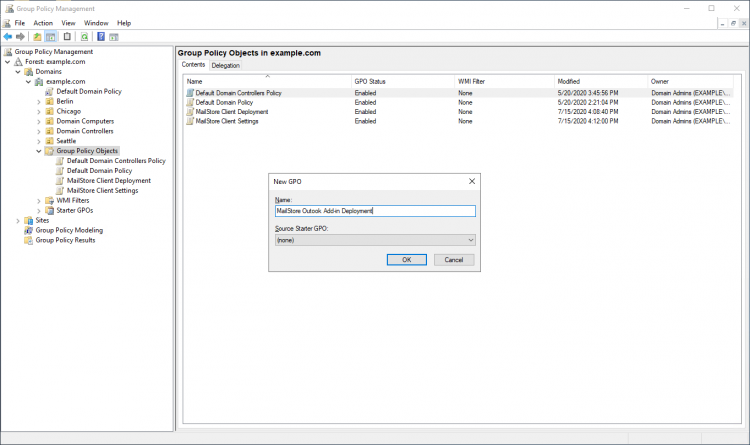
- Right-click the new GPO and select Edit....
- Expand User Configuration > Policies > Software Settings.
- Right-click Software Installation and select New > Package....
- Select the MSI package mentioned above. Make sure to enter the file path in UNC notation (e.g., \Server\Setup\MailStoreSetup...) and ensure that domain users have read access to this share.
- In the following dialog box, select Advanced and click OK.
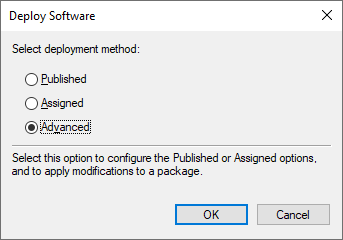
- On the next screen, set the options on the Deployment tab as shown below:
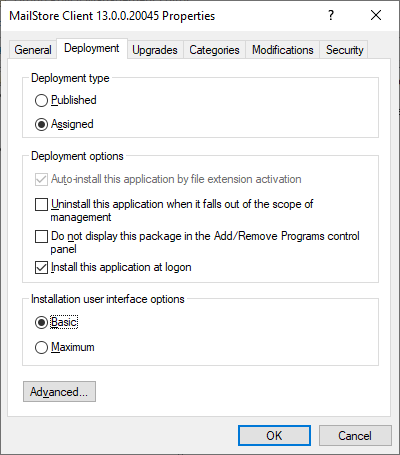
- Click OK to confirm all settings.
- The group policy should now look similar to the following:
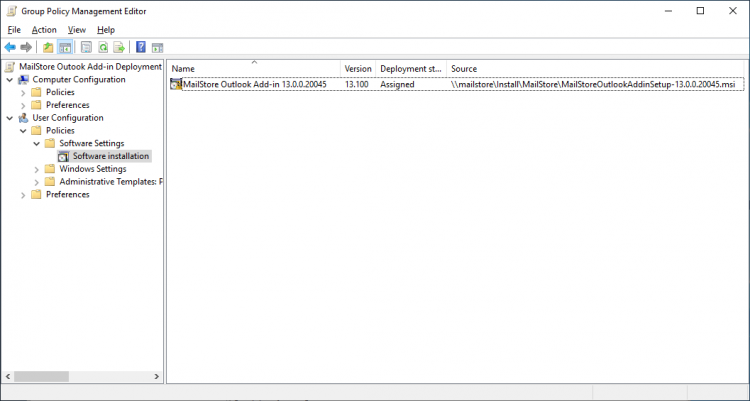
- Close the Group Policy Editor.
The group policy is now configured and can be linked to the relevant user objects. Linking is done via organizational units (OU).
- Highlight the organizational unit (OU) containing the desired user objects, right-click the OU (e.g., Seattle in the example), and select Link an Existing GPO....
- In the dialog box, select the GPO MailStore Client Deployment, highlight it, and click OK.
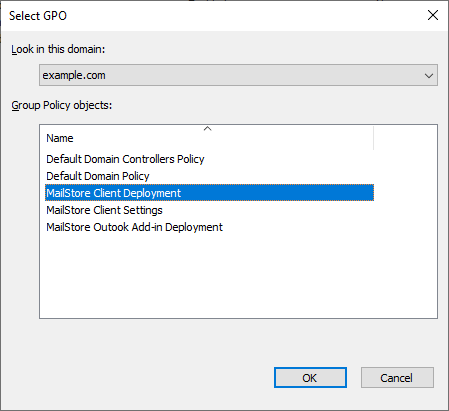
- The group policy is now linked via the organizational unit to the user objects listed here. The settings will become active during the next login on the Windows clients.
Please note: To prevent issues when deploying software via group policies, the following settings should be applied via group policy to computer objects representing the Windows clients of MailStore users:
- Computer Configuration > Administrative Templates > System > Run only specified Windows applications
- Configuration > Administrative Templates > System > Always wait for the network at computer startup and logon
Update
The MailStore Client MSI is essentially a loader that installs the latest components of the MailStore Client from the MailStore Server. When the loader itself needs to be updated, group policies can automatically perform the update on MailStore user computers. To enable clients to be automatically updated, please follow these steps to edit the existing MailStore Client Deployment group policy:
- Open the Group Policy Management Console on your domain controller.
- Navigate to the Group Policy Objects management folder.
- Right-click the existing MailStore Client Deployment GPO and select Edit....
- Expand User Configuration > Policies > Software Settings.
- Right-click Software Installation and select New > Package....
- Select the updated MailStore Client MSI package. Make sure to enter the file path in UNC notation (e.g., \Server\Setup\MailStoreSetup...) and ensure that domain users have read access to this share.
- In the following dialog box, select Advanced and click OK.
- On the next screen, set the options on the Deployment tab as shown below:
- On the Upgrades tab, a list of upgradable packages is displayed. Select the Required upgrade for existing packages option.
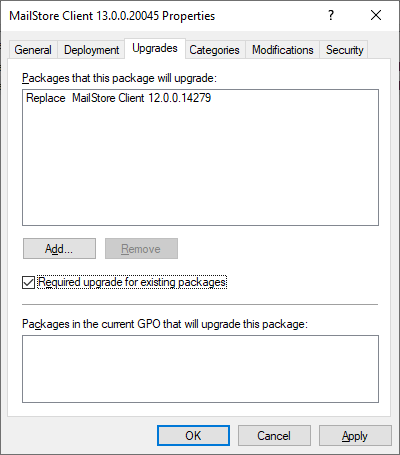
- Click OK to confirm all settings.
- The group policy should now look similar to the following:
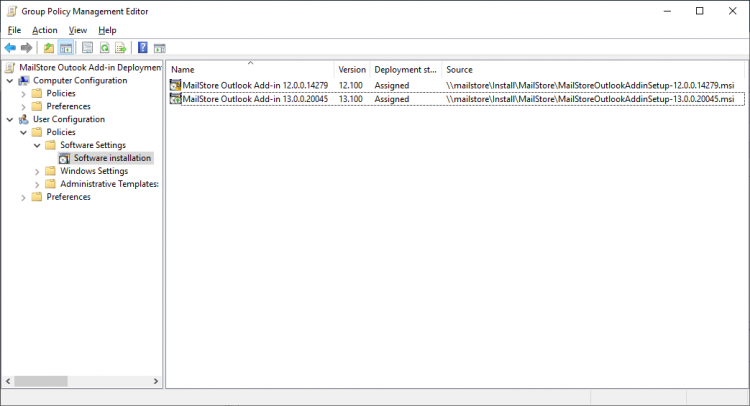
The MailStore Client loader will be updated during the next logon on the users' Windows workstations.
Configuration
If MailStore Server is used within an Active Directory infrastructure, the MailStore Client and MailStore Outlook Add-in can be configured using group policies. Settings configured via group policies override local settings and cannot be changed by users.
For this purpose, group policy templates are available as ADMX files (for Windows 7 SP1 and Windows Server 2008 R2 or later).
Installing the ADMX Template
Group policy templates can be managed locally on a management workstation or centrally in a domain. For more details, please see Microsoft Technet.
Installing the ADMX Template Locally
- Download the ADMX templates to your management workstation.
- Extract the package preserving the folder structure to the %systemroot% directory.
Installing the ADMX Template Centrally
Note: Use this method only if you are already using a central repository for group policies; otherwise, the group policies stored locally will no longer be accessible.
- Download the ADMX templates to your domain controller.
- Extract the package preserving the folder structure to the domain\policies directory within the SYSVOL folder (default: %systemroot%\sysvol\domain\policies).
To verify the installation and proceed with further configuration, follow these steps:
- Open the Group Policy Management Console.
- Right-click the Group Policy Objects management folder.
- Select New and create a new group policy object named MailStore Client Settings.
- Right-click the new GPO and select Edit....
- Expand User Configuration > Policies > Administrative Templates.
- If the templates are correctly installed, there will be a MailStore entry and sub-entries for MailStore Client and MailStore Outlook Add-in.
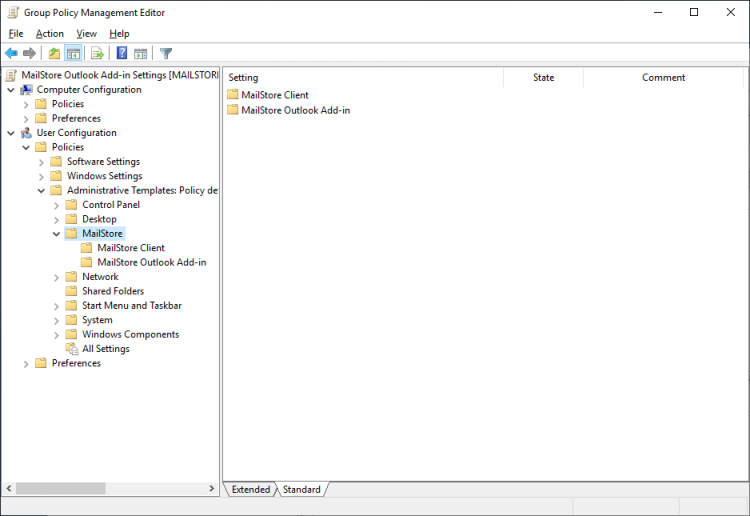
Configuring Policy Settings
- Open the Group Policy Management Console.
- Right-click the Group Policy Objects management folder.
- Right-click the existing MailStore Client Settings group policy object and select Edit....
- Expand User Configuration > Policies > Administrative Templates under MailStore > MailStore Client.
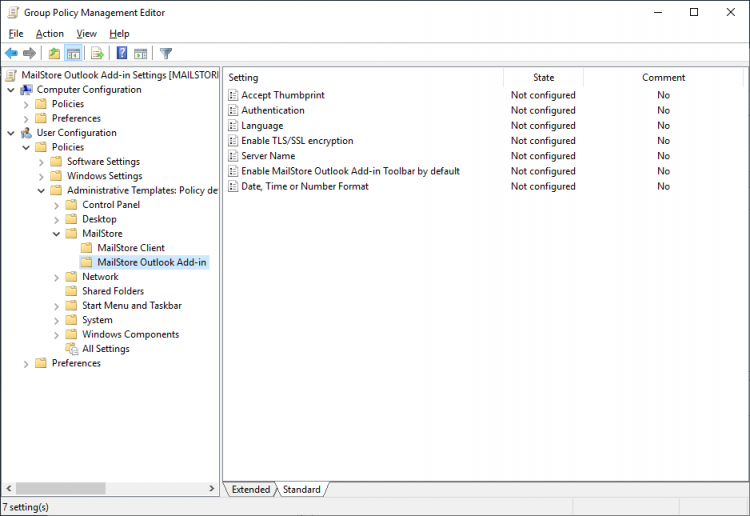
The following settings are supported by the current MailStore Client:
- Authentication Method: Sets the authentication method to Standard Authentication or Windows Authentication. If Windows Authentication is selected, the Server Name must also be set.
- Language: Sets the display language of the MailStore Client. To use the operating system's language on the client, select System Language.
- Remember Password: This setting stores the user's password locally on the client after it is entered, provided that the authentication method is also set to Standard Authentication.
- Server Name: If this parameter is provided, the MailStore Client always connects to this server. If the authentication method is also set to Windows Authentication, the login to MailStore Server occurs directly without any user interaction (Single Sign-On). If the MailStore Client is configured to use a different port than the default (8460), this parameter should be provided as Server Name:Port.
Applying Policy Settings
To apply these settings to users, the group policy must be linked to the relevant user objects. Linking is done via organizational units (OU).
- Highlight the organizational unit (OU) containing the desired user objects, right-click the OU (e.g., Seattle in the example), and select Link an Existing GPO....
- In the dialog box, select the GPO MailStore Client Settings, highlight it, and click OK.
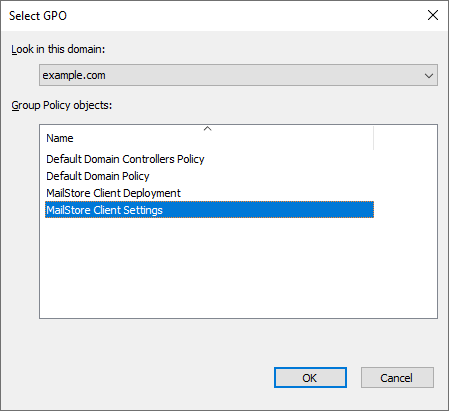
- The group policy is now linked via the organizational unit to the user objects listed here. The settings become active during the next login on the Windows clients.
Uninstallation
Just like deployment, uninstalling software packages can also be done using group policies. Please proceed as follows:
- Open the Group Policy Management Console on your domain controller.
- Navigate to the Group Policy Objects management folder.
- Right-click the existing MailStore Client Deployment GPO and select Edit....
- Expand User Configuration > Policies > Software Settings.
- Right-click the package to be uninstalled and select All Tasks > Remove....
- In the following dialog box, select Uninstall the software from users and computers immediately and click OK.
- Close all open windows and exit the Group Policy Editor.
The MailStore Client will be uninstalled during the next login on the users' Windows workstations.
Source: MailStore Outlook Add-in Deployment - MailStore Server Help