
الوصول إلى الأرشيف باستخدام برنامج MailStore Client
يمكنك أيضًا توزيع تطبيق MailStore Client على الحواسيب العميلة باستخدام ميزة Group Policy في Active Directories بدلًا من تثبيته يدويًا.


Installation and Update
The MailStore Client installation file matching your MailStore Server version is stored on the MailStore Server machine. Follow the link Install MailStore Client on Other Computers from Your Desktop and copy the relevant installation file to the client computer.
Double-clicking on the installation file is a standard Windows installation program that can be executed on the appropriate client computer. Simply follow the instructions on the screen.
If an update is loaded onto the MailStore Server machine, the MailStore Client automatically updates itself during the first login to remain compatible with the MailStore Server. Therefore, it is usually not necessary to reinstall the MailStore Client.
Starting and Logging In
Use the appropriate link on your desktop to start the MailStore Client.
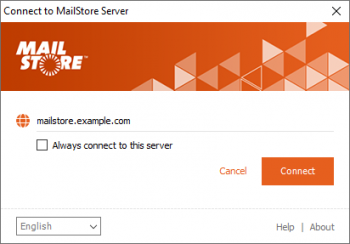
The Connect to MailStore Server window opens.
- Enter the DNS host name of the computer where MailStore Server is installed in the Server Name field. Remember that the pre-filled localhost entry only works if the MailStore Client is run on the machine where MailStore Server is installed.
- Click Connect to connect to MailStore Server.
Note: If you always want to connect to this server and later change the target server, hold down the Shift key when opening the MailStore Client.
After connecting to MailStore Server, MailStore Client checks whether a newer version of its program files can be downloaded and automatically updates them if necessary.
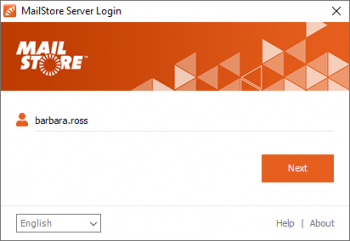
After a successful connection, the user name dialog box appears.
- Enter the user name of a MailStore user in the User Name field and click Next.
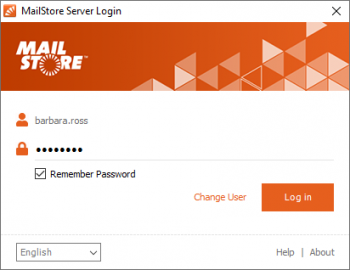
MailStore Server now determines how to verify the user's identity.
-
If MailStore Server can verify the user's credentials itself, the password dialog box appears as shown on the right. Enter the password in the Password field and click Log In.
-
If the user authenticates via Microsoft 365, Google Workspace, or Active Directory Federation Services (AD FS), the default web browser opens to allow authentication via Microsoft's, Google's, or AD FS's identity service.
-
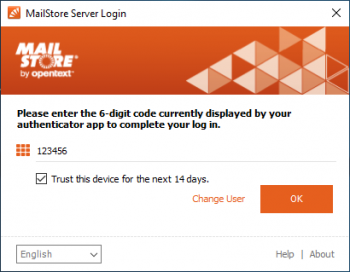 If Multi-Factor Authentication (MFA) is enabled and the current device is not trusted, the user needs to enter an MFA code.
MailStore Folder Structure
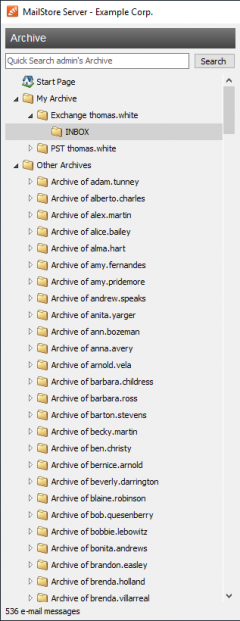
For each user, MailStore creates a folder at the top level of the folder structure corresponding to the user's archive. This folder contains all emails archived for that user and is labeled My Archive.
If a user has access to other MailStore users' archives (for example, as a MailStore administrator), the folders are listed as Archive.
Under these main folders, individual email sources (e.g., Microsoft Outlook or Exchange mailboxes) and their folder structures (e.g., Inbox) are listed.
Note: For MailStore administrators, access to other users' archives via the folder structure is disabled by default; this setting can be changed in compliance settings. In addition, MailStore administrators can manage archives via the Archives page.
Deleting Folders
Folders and emails within them can only be deleted after the appropriate user privileges have been explicitly assigned by an administrator. If there are any subfolders in the folder to be deleted, they will also be deleted.
Manually Moving, Renaming, and Creating Folders
Folders can be moved, renamed, or created within MailStore. Normal users can only do this within their own user archives, while MailStore administrators can move and rename folders across user archive boundaries. During archiving, MailStore adopts the folder structure and folder names (e.g., Microsoft Outlook) from the source.
Please note that since the target user's full-text index must collect the moved emails, moving large archives across user archive boundaries may take some time.
The features New Folder..., Rename, and Move to Folder... can be accessed by right-clicking on the relevant archive folder.
If a MailStore administrator renames a user archive (Folder: Archive) without renaming the associated user, it will be an empty archive until renamed.
Note: Using an existing folder name when renaming a folder allows merging the contents of both folders.
Changing Message Type
If the sender or recipient of a message is incorrectly displayed or vice versa, an administrator can change the message type of the message.
Highlight the emails and select Change Message Type from the context menu.
For changing the message type of other users' messages, you must first disable archive access restrictions.
To ensure the message type is correctly set during archiving, verify the archiving profile settings if needed.
Deleting Emails
Hold down the Ctrl key and click on the emails you want to delete (this will highlight all emails). Right-click on the highlighted items and select Delete. Users can only delete emails if they have been explicitly granted this privilege by a MailStore administrator. Ctrl+A
Please note that it is generally not recommended to allow users to delete emails; assigning such privileges may complicate compliance with legal requirements for email storage.
Moving Emails
Hold down the Ctrl key and click on the emails you want to move (this will highlight all emails). Right-click on the highlighted items, select Move to Folder..., and choose a target folder. Alternatively, drag and drop the highlighted emails to the target folder. Emails can only be moved within a single user archive unless you are a MailStore administrator. Ctrl+A
Searching by Folder Structure
MailStore sorts all archived emails according to its own folder structure. Under the main folders, individual email sources (e.g., Microsoft Outlook or Exchange mailboxes) and their folder structures (e.g., Inbox) are listed.
Viewing Emails in a Folder
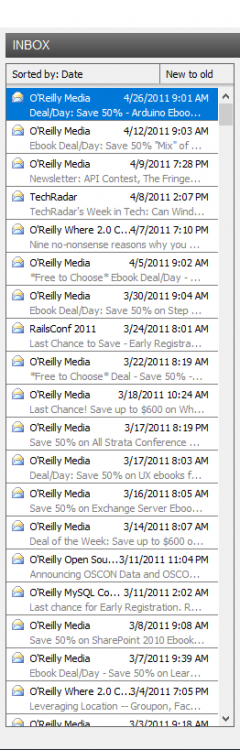
To view emails in a folder, simply click on the folder name. The emails will be listed under the folder structure.
To change the order in which emails are displayed, click on the Sort By text. Emails can be sorted by:
- Date
- From/To (the sender or recipient of the email)
- Subject
To reverse the order in which emails are displayed, click on the area to the right of Sort By (as shown in the screenshot, "Newest to Oldest"). By default, the most recent email is displayed first.
Refreshing the View
To refresh the folder list, click on a folder and press the F5 key on your keyboard.
To refresh the email list, click on the folder again.
Starting an Advanced Search in a Folder
To start an advanced search in a folder, right-click on the folder and select Search Here.... The Advanced Search will be displayed, and the folder is pre-selected.
Quick Search
Quick search allows you to view all emails in the archives you have access to. This feature is especially suitable for simple queries; alternatively, advanced search can be used.
Using Quick Search
The search field is located in the top-left corner of the MailStore Client. Enter one or more keywords and press ENTER. The search results are displayed. Keywords appearing in the subject line or the message header are highlighted.
Searching for Word Parts
To display all emails containing a word with specific parts, use the wildcard character (*). For example:
- auto* would return Automatic, automatic, automobile, etc.
- example.com would return all email addresses and domain names containing example.com.
- firstname.lastname would return all email addresses containing firstname.lastname.
Searching for Words with Unknown Letters
To display all emails containing a word of which you are unsure of the exact spelling, use the question mark (?). For example:
- Me?er would find Meier and Meyer, but not Maier.
- The question mark (?) cannot be used at the beginning or end of a word; instead, use the wildcard character (*).
Searching for Phrases
To search for words appearing consecutively and in a specific order, use quotation marks ("). For example:
- "Microsoft Windows" would return Windows in the context of Microsoft, but not Microsoft Works or Windows 95.
Narrowing Down by Fields
A search for keywords or word blocks can be limited to specific fields. For example:
- subject:News would search only in the Subject field.
- from:john@mailstore.com would search only in the From field.
- to:michael@mailstore.com would search only in the To field.
- cc:lisa@mailstore.com would search only in the Cc field.
- bcc:customers@mailstore.com would search only in the Bcc field.
- bcontent:billing would search only in the body of the message.
- acontent:billing would search only in the attachments of the message.
Excluding Words from Search
To narrow down a search, you can specify words that should not appear in the emails. To exclude a word from the search results, add a minus character (-) before the word. For example:
- ZDNet -download-tip would return all emails from ZDNet that do not contain the phrase download tip.
Combining Search Options
Any of the search options described above can be combined. For example:
- ZDNET -"Daily Update" would return all emails from ZDNet that do not contain the consecutive phrase Daily Update.
- from:ZDNET bcontent:MailStore would return all emails from ZDNet that contain MailStore in the body of the message.
- from:billing@example.com acontent:bill would return all emails from billing@example.com that have an attachment containing bill.
- to:recruiting@example.com -sales would return all emails sent to recruiting@example.com that do not contain the word sales in any part of the message.
- from:billing@example.com to:myaddress@company.tld acontent:bill -subject:admonition would return all emails from billing@example.com to myaddress@company.tld that have an attachment containing bill, but do not contain the word admonition in the subject line.
About Special Characters
Words that appear in emails or attachments, which are combinations of alphanumeric (letters and numbers) and non-alphanumeric characters (space, line break, delimiter or other control characters), can only be returned in search results when searching for the alphanumeric part.
For example, a search for ad, ad.soyad, and soyad would return emails containing the word ad.soyad.
Commonly used characters include:
- Period (.)
- Comma (,)
- Semicolon (;)
- Hyphen (-)
- Underscore (_)
- At sign (@)
- Forward slash and backslash (/, )
- Null character (NUL)
Advanced Search
Using advanced search, you can perform complex queries via the MailStore Client. The scope of the queries can be specified according to certain archive folders and not only refer to email content but also include fields such as email date, archiving date, or email size. Email attachments can be searched specifically if the indexing options are appropriately configured.
Using Advanced Search
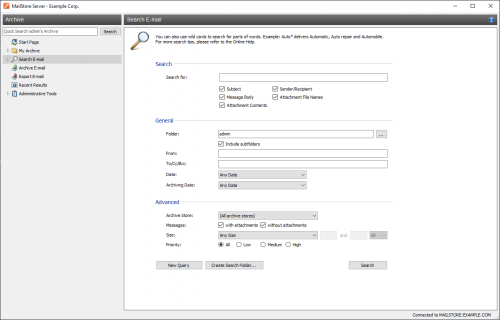
In the MailStore Client, click Search Email and enter the search parameters. The criteria are combined with AND, so that the search only returns emails that meet all the criteria. Click Search to start the search.
Search Criteria under "Search"
Enter a keyword or word phrase in the text field and specify where MailStore should search. The following options are available:
- Subject - Searches the subject line of the email.
- Sender/Recipient - Searches the "From", "To", "Cc", and "Bcc" fields.
- Message Body - Searches the plain text or HTML sections of the email (if available).
- Attachment File Names - Searches the file names of the email attachments.
- Attachment Content - Searches the content of the email attachments. Whether the attachments can be searched and to what extent depends on the specified indexing options.
All options described in the Quick Search section, such as word phrases and wildcard characters, are also available in the Search Text field.
Search Criteria under "General"
Under General, the following options are available:
- Folder - The folder to be searched by MailStore can be selected from here. By default, all folders that can be read by the current user are selected. You can also select folders using the folder structure by clicking on the button next to the text field.
- Include Subfolders - If selected, MailStore searches not only the selected folder (e.g., Inbox) but also all subfolders created within it (e.g., Inbox / Projects 2008 / Cost Optimization).
- From - All keywords or email addresses entered here are searched only in the sender field of the email.
- To/Bcc - All keywords or email addresses entered here are searched only in the recipient fields of the email.
- Date - The time period covered by the search can be selected from here. A predefined range such as Yesterday or This Year can be selected, or Custom can be selected to manually specify a certain period. In this case, the start and end dates will be included.
- Archiving Date - The time frame covered by the search can be selected from here. A predefined range such as Yesterday or This Year can be selected, or Custom can be selected to manually specify a certain period. In this case, the start and end dates will be included.
All options such as phrases and wildcard characters described in the Quick Search section are also available in the From and To/Bcc fields.
Search Criteria under "Advanced"
Under Advanced, the following options are available:
- Archive Repository - If the archive consists of multiple archive repositories, the search can be limited to only one of them. By default, all archive repositories are searched.
- Messages with/without Attachments - By default, all messages are searched regardless of whether they have an attachment or not. To exclude certain types of emails from the results, uncheck one of the boxes. Note: Elements such as background images may be considered attachments, so these searches may not always be accurate.
- Size - By default, all messages are searched regardless of their size. Use the provided fields to limit the search by message size, for example, messages larger than 5 MB or between 400 KB and 600 KB.
- Priority - Messages are searched according to the priority level assigned by the sender. If Low is selected, all messages with a priority level lower than Normal are returned. If High is selected, all messages with a priority level higher than Normal are returned. If no information about the priority is provided, it is assumed to be Normal.
Starting the Search
Click Search to start the search. The results are displayed in a list on the left side of the main window.
Improving Search Results
After running a search, you can further narrow down the results by clicking Search Email again. Specify any additional search criteria and click Search once more.
Starting a New Search
To start a new search, click New Query. All search criteria will be reset to their default values (i.e., searching through all folders that can be read by the current user without restrictions).
Saving Search Criteria for Reuse
Frequently used search criteria, such as "all invoices from last month," can be saved and reused later: Click Create Search Folder and give the search a meaningful name.
The new search folder will be located under the Search Email folder on the left side of the application window.
Through the context menu, you can view, rename, or delete a search folder (New Search Query).
About Special Characters
Words that appear in emails or attachments, which are combinations of alphanumeric (letters and numbers) and non-alphanumeric characters (space, line break, delimiter or other control characters), can only be returned in search results when searching for the alphanumeric part.
For example, a search for ad, ad.soyad, and soyad would return emails containing the word ad.soyad.
Commonly used characters include:
- Period (.)
- Comma (,)
- Semicolon (;)
- Hyphen (-)
- Underscore (_)
- At sign (@)
- Forward slash and backslash (/, )
- Null character (NUL)
Email Preview
MailStore offers an integrated email preview that displays emails in the same way as standard email applications. To enable the preview, simply click on an email or use the arrow keys to highlight the desired email in the list.
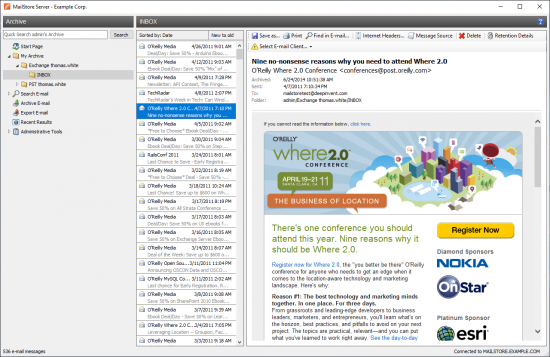
The menu bar above the email preview displays all functions available for the currently displayed email.
Save As...
To save the current email to any Windows folder, click Save As.... Emails can be saved in the following file formats:
- RFC822 EML - These files can be opened independently of MailStore by double-clicking and can be transferred to applications such as Mozilla Thunderbird using the drag-and-drop method.
- Outlook MSG - These files can be opened or imported directly into all versions of Microsoft Outlook.
Using the print function, the currently displayed email will be printed, including header information such as Date and Subject.
Find in Email
To search the message body of the current email, click Find in Email.
Internet Headers...
To view the headers of the current email, including all MIME parts, click Internet Headers.
Message Source
To display the full source of the current message, including all MIME parts, click Message Source.
Delete (Only with Appropriate Privileges)
To delete the current email from the archive, click Delete. Please note that you must have the appropriate privileges to use this function.
Storage Details (Only for Administrators)
This button is only available if retention policies are configured and enabled.
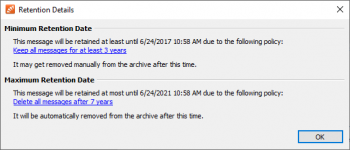
Click Storage Details to view the minimum and maximum storage dates and any relevant retention policies. By clicking on a retention policy, you can view its configuration directly.
Reopening Emails in an Email Client
Emails